

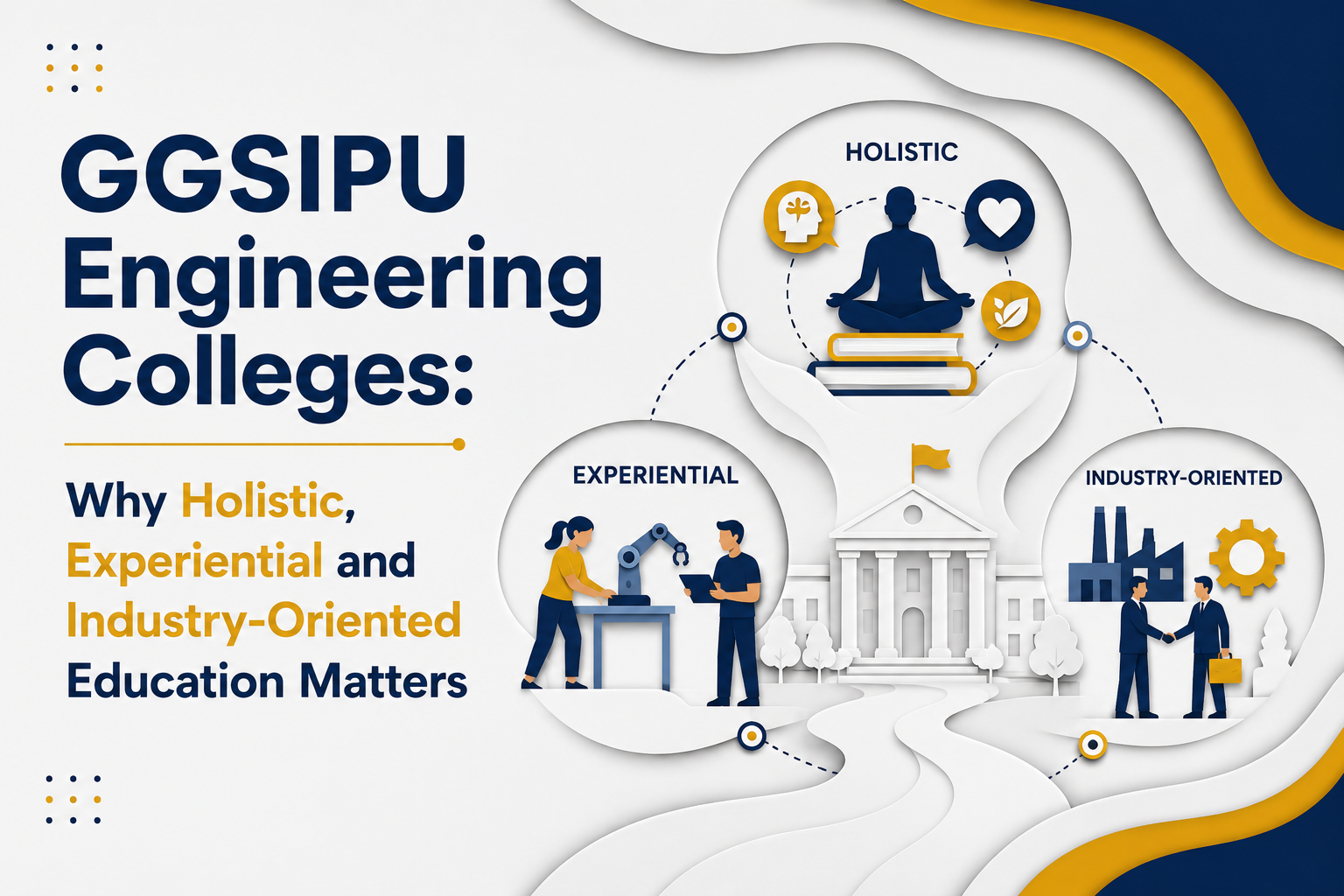
GGSIPU Engineering Colleges: Why Holistic, Experiential and Industry-Oriented Education Matters
On this page
- Why Is Engineering Education Changing?
- Practical Education and Engineering Students
- Artificial Intelligence & Machine Learning
- Cybersecurity
- Cloud Computing
- Networking
- Internet of Things
- Robotics and Automation
- Mechatronics
- Advanced Computing and Software Development
- Practical Learning
- Technology Exposure
- Laboratory-Based Learning
- Innovation
- Skill Development
- Career Orientation
- What is holistic education in engineering?
- What is experiential learning?
- Why is learning by doing important?
- What is practical education?
- What is industry-oriented education?
- Why is skill-based learning important for engineering students?
- What is innovation-based learning?
- What is multidisciplinary education?
- What is technology-driven education?
- Why should students consider Echelon Institute of Technology?
- Is practical learning useful for B.Tech students?
GGSIPU Engineering Colleges: Why Holistic, Experiential and Industry-Oriented Education Matters
Choosing an engineering college is one of the most important decisions a student makes after completing Class 12. While factors such as entrance examination rank, fees, location, courses and placements remain important, the quality of the learning experience can have an equally significant impact on a student's development.
Engineering is a practical discipline. Students do not only need to understand theories; they also need to know how those theories are applied to real-world problems.
This is why concepts such as holistic education, experiential learning, practical education, learning by doing, skill-based learning, innovation-based learning and industry-oriented education are becoming increasingly relevant when students compare engineering colleges.
For students exploring GGSIPU engineering colleges, these factors can provide a useful framework for evaluating different institutions.
One college that students can consider while exploring this approach is Echelon Institute of Technology, Faridabad.
Why Is Engineering Education Changing?
The engineering industry is evolving rapidly.
Technologies such as artificial intelligence, machine learning, cloud computing, cybersecurity, Internet of Things, robotics, automation and data-driven systems are changing the way organisations operate.
As a result, employers increasingly look for graduates who can combine academic knowledge with practical skills.
A student may know the theoretical definition of artificial intelligence, for example, but practical exposure to an AI project can provide a much deeper understanding of how the technology works.
Similarly, reading about computer networks is different from actually configuring and troubleshooting a network.
This difference highlights the importance of experiential learning.
What Is Experiential Learning?
Experiential learning is an educational approach where students learn through direct experience.
Instead of limiting learning to lectures and textbooks, students get opportunities to apply concepts through activities such as:
Laboratory experiments
Technical projects
Workshops
Internships
Simulations
Competitions
Innovation projects
Problem-solving activities
Industry interactions
The basic idea is simple:
Learn → Apply → Experiment → Analyse → Improve
This approach can help students develop both conceptual understanding and practical confidence.
For engineering students, experiential learning can be especially valuable because many technical concepts become easier to understand when students can see them working in a practical environment.
What Is Holistic Education?
Holistic education focuses on the overall development of a student rather than academics alone.
For an engineering student, holistic development can include:
Academic knowledge
Technical skills
Communication skills
Teamwork
Creativity
Leadership
Critical thinking
Problem-solving
Innovation
Professional confidence
Engineering graduates eventually work with people, projects, deadlines and customers.
Therefore, technical knowledge needs to be supported by communication and professional skills.
A holistic education model attempts to bring these different aspects together.
Practical Education and Engineering Students
Engineering is fundamentally connected with application.
Students learn about systems, machines, software, networks, electronics and processes because these concepts are eventually used to solve real problems.
Practical education gives students opportunities to experience this application.
Laboratory work, projects and technical activities can help students understand:
“How does this concept actually work outside the textbook?”
That question can become an important part of engineering education.
Why Laboratory Infrastructure Matters
When comparing GGSIPU B.Tech colleges, students often look at campus facilities and laboratories.
However, the number of laboratories alone should not be the deciding factor.
Students should ask:
What technologies are covered?
Are students allowed to work on projects?
How frequently can students use the facilities?
Are practical activities connected with the curriculum?
Are students encouraged to experiment?
Can students develop prototypes or technical solutions?
A technology-focused laboratory environment can provide exposure to different areas of engineering.
Echelon Institute of Technology: Focus on Technology and Practical Learning
Echelon Institute of Technology, Faridabad can be considered by students who are looking for a learning environment that combines academics with practical and technology-oriented exposure.
The institute's learning ecosystem includes areas connected with emerging technologies and engineering applications.
These include areas such as:
Artificial Intelligence & Machine Learning
AI and ML have become important areas across software, business, healthcare, finance, manufacturing and other industries.
Practical exposure can help students understand concepts such as machine learning models, data-driven systems and intelligent applications.
Cybersecurity
With organisations becoming increasingly dependent on digital systems, cybersecurity has become an important technology area.
Students can explore concepts related to network security, digital security and cyber threats.
Cloud Computing
Cloud computing is widely used for modern digital infrastructure.
Students can develop an understanding of cloud environments, virtualisation, deployment and resource management.
Networking
Networking forms the foundation of communication between computers and digital systems.
Practical networking exposure can help students understand configuration, connectivity and troubleshooting.
Internet of Things
IoT combines sensors, devices, networks and software.
Students can explore how physical devices communicate with digital systems and how connected technologies can be used in real-world applications.
Robotics and Automation
Robotics brings together areas such as mechanical systems, electronics, programming and control.
It can provide students with an opportunity to understand automation and intelligent systems.
Mechatronics
Mechatronics combines mechanical engineering, electronics, control systems and computing.
This multidisciplinary nature makes it relevant to modern industrial applications.
Advanced Computing and Software Development
Software development remains an important career area for engineering graduates.
Programming, application development, software engineering and project-based learning can help students develop a stronger technical foundation.
Industry-Oriented Education: Preparing Students for Professional Life
A major difference between academic education and professional life is application.
In college, students are often evaluated through examinations, assignments and projects.
In professional environments, they may be expected to:
Solve problems
Work in teams
Communicate effectively
Meet deadlines
Understand requirements
Use professional tools
Develop solutions
Adapt to new technologies
This is where industry-oriented education becomes relevant.
The purpose is not to replicate a corporate office inside a college.
Instead, it is to give students greater awareness of how technical knowledge is used in professional environments.
Skill-Based Learning for Future Careers
A degree is important, but students also need skills.
This is why skill-based learning has become an important part of modern education.
Engineering students can develop skills through:
Technical projects
Internships
Workshops
Hackathons
Competitions
Certifications
Laboratory activities
Research
Innovation projects
Depending on their branch and interests, students may develop skills in areas such as programming, AI, cloud computing, cybersecurity, networking, electronics, automation and data technologies.
Technology-Driven Education
Technology is not limited to computer science.
Today, technology influences almost every engineering discipline.
Mechanical engineers may work with automation and robotics.
Electronics engineers may work with embedded systems and IoT.
Computer engineers may work with AI, cloud computing and cybersecurity.
Therefore, technology-driven education can provide students with broader exposure to the tools and concepts influencing modern industries.
Innovation-Based Learning
Education should not only teach students how existing systems work.
It should also encourage them to ask:
Can this be improved?
Can this problem be solved differently?
Can technology make this process faster, cheaper or more accessible?
This is the foundation of innovation-based learning.
Projects and experimentation can encourage students to move from simply consuming information to creating solutions.
Innovation can also help students explore entrepreneurship and research.
Multidisciplinary Education
Many modern technologies combine several disciplines.
Consider an autonomous robot.
It may require:
Mechanical engineering
Electronics
Sensors
Programming
Artificial intelligence
Control systems
Similarly, an IoT solution may involve:
Embedded systems
Networking
Software
Sensors
Data processing
This is why a multidisciplinary approach can be valuable.
Students who understand how different disciplines connect may be better prepared to work on complex technical problems.
Future-Oriented Education
One of the biggest challenges in education is preparing students for a future that cannot be predicted perfectly.
Technologies change.
Job roles change.
Industry requirements change.
Therefore, students need more than knowledge of one particular tool.
They need the ability to learn continuously.
This is the foundation of future-oriented education.
A future-ready student should ideally be comfortable with:
Learning new technologies
Solving unfamiliar problems
Working collaboratively
Adapting to changing situations
Exploring new ideas
Developing new skills
Why Echelon Institute of Technology Can Be Considered
Students comparing engineering colleges in Delhi NCR can evaluate Echelon Institute of Technology on several parameters.
Practical Learning
The learning environment gives importance to practical exposure and application-based education.
Technology Exposure
Students can explore emerging technology areas through specialised learning environments.
Laboratory-Based Learning
Laboratory activities can complement classroom education.
Innovation
Project-based learning can provide opportunities to experiment with ideas and develop solutions.
Skill Development
Students can work towards developing technical and professional skills alongside academic knowledge.
Career Orientation
The combination of technical learning, practical exposure and professional development can support career preparation.
How Should Students Compare GGSIPU Engineering Colleges?
There is no single factor that can determine whether a college is right for every student.
Instead, students should create their own comparison.
Parameter | What Students Should Check |
|---|---|
Course | Desired B.Tech branch available? |
Academics | Faculty and curriculum |
Labs | Practical facilities |
Technology | Emerging technology exposure |
Projects | Project opportunities |
Industry | Industry interactions |
Internships | Internship opportunities |
Placements | Placement ecosystem |
Fees | Overall cost |
Location | Travel and accessibility |
Campus | Student facilities |
Career | Alignment with goals |
This approach can help students make a decision based on their own priorities rather than simply following a generic ranking.
What Should a Student Look for in a Future-Ready College?
A future-ready college should ideally provide a combination of:
Strong academics
Practical education
Technology exposure
Industry orientation
Skill development
Innovation
Career preparation
No single component is enough on its own.
A student may have excellent infrastructure but limited practical exposure.
Another institution may have good academics but fewer opportunities for technology projects.
Therefore, students should look at the complete ecosystem.
Frequently Asked Questions
What is holistic education in engineering?
Holistic education focuses on the overall development of engineering students, combining academic knowledge with technical skills, communication, teamwork, creativity, problem-solving and professional development.
What is experiential learning?
Experiential learning allows students to learn through practical experiences such as laboratory work, projects, workshops, internships and problem-solving activities.
Why is learning by doing important?
Learning by doing allows students to apply theoretical concepts and understand how systems work in practical situations.
What is practical education?
Practical education connects classroom concepts with laboratory activities, projects, experiments and real-world applications.
What is industry-oriented education?
Industry-oriented education attempts to connect academic learning with professional requirements through practical projects, workshops, internships and industry exposure.
Why is skill-based learning important for engineering students?
Skill-based learning helps students develop abilities they can practically demonstrate, complementing their academic qualifications.
What is innovation-based learning?
Innovation-based learning encourages students to identify problems, experiment with ideas and develop new or improved solutions.
What is multidisciplinary education?
Multidisciplinary education brings knowledge from different academic areas together to help students understand complex problems.
What is technology-driven education?
Technology-driven education incorporates modern technologies and digital tools into the learning process and exposes students to emerging technology areas.
Why should students consider Echelon Institute of Technology?
Students looking for a technology-oriented and practical learning environment in the GGSIPU ecosystem can consider Echelon Institute of Technology while comparing factors such as academics, labs, courses, fees, location, placements and career opportunities.
Is practical learning useful for B.Tech students?
Yes. Practical learning can help B.Tech students understand how theoretical concepts are applied to real-world engineering problems.
Final Thoughts
Selecting a GGSIPU engineering college is ultimately a personal decision.
Students should consider their preferred branch, academic interests, career plans, budget, location and learning preferences.
At the same time, the changing nature of engineering careers makes it important to look beyond conventional classroom education.
Holistic education, experiential learning, learning by doing, practical education, industry-oriented education, future-oriented education, skill-based learning, innovation-based learning, multidisciplinary education and technology-driven education can all contribute to a more comprehensive engineering learning experience.
For students exploring these aspects within the GGSIPU ecosystem, Echelon Institute of Technology, Faridabad is an institution worth including in their comparison.
The goal should ultimately be simple:
Learn deeply. Practise regularly. Build skills. Experiment with ideas. Prepare for the future.
Because the best engineering education is not only about earning a degree—it is about developing the knowledge, skills and confidence needed to create a career.
Not sure which college is right for you?
Talk to a free counsellor — no cost, no obligation.